
What's Up Kaspi?
A quick check-in on our favorite (?) business.

Disclosure: Not financial advice. Do your own research.
KSPI 0.00%↑ has been through the ringer since we first wrote about this incredible company back in September of 2025. Continuing its decline from $88 then to finding a bottom at around $70, and now back up to the $80-$85 range. Amidst that turbulence, one thing hasn’t changed, and that’s management’s commitment to shareholder returns.
Before we jump to the present, let’s take a quick step back and put Kaspi into perspective. Right now, the current S&P 500 P/E ratio (earnings multiple) sits at about 31 and a half — it’s median and mean are roughly 15 and 16, respectively. It’s hard to argue that the market isn’t elevated. But we’re not here to argue if that’s rational. There’s wisdom of the crowds and the crowds are pulling forward lots of future growth. As AI increasingly drives society, it’s unwise to dispute its profound impact.
<End Rant>
Back to Kaspi. KSPI’s earnings multiple sits at around 7.30. At a share price of $82.77 at the time of writing this article, Kaspi is guiding to generate $11.73 net income per share, on the low end and without factoring in share buybacks.
Since the company is highly disregarded and overlooked, only one analyst provides earnings projections for 2026 and beyond. Those projections offer a 2027 EPS of $15.11 per share. At the current share price of $82.77, that’s a forward multiple of 5 and a half.
Why does this valuation matter?
In physics there’s this really important phenomena called Max q - the maximum dynamic pressure experienced during things like rocket launches. Essentially, it’s the point at which failure is most likely, since the structural load placed on the vehicle peaks. This past year, Kaspi has been going through its period of Max q.
But don’t rest your laurels on me, just listen to Kaspi’s management:
Temporary disruption in smartphone supply
Regulatory and tax changes
Higher 2025 base rate
Heightened capex on Hepsiburada acquisition
All of these are external factors negatively suppressing the stock price. And despite all that, Kaspi was able to put up 20% revenue growth in Q3 2025. Net income? 12% YoY. (Note these figures exclude Hepsiburada). Excluding the others — taxes, elevated base rate, smartphone disruption — Kaspi achieved 23% revenue growth and 21% net income growth year-over-year.
On top of this, Kaspi continues to execute on multiple business fronts. They introduced Alaqan Pay with palm. Kaspi Travel has grown to 5 million customers. Kaspi Restaurants launched, allowing customers to pay by QR code at restaurants. Third party ads on Kaspi Market. Glovo food-delivery partnership. And so much more. While this is dandy and all, what about shareholders? What about the shareholders who’ve held through the nearly 50% drawdown from around $138 in 2024 to $70 in 2025?
Here’s where things get interesting.
Despite an extremely tough environment, Kaspi is executing incredibly well. Growth of 20% on the top-line for a business that has over 50% digital banking/payments market share and over 70% e-commerce. Though, high growth in grocery and travel verticals help. The point is, the business is continuing to compound at fantastic rates, while external, largely temporary variables are artificially suppressing the share price.
This is the best case scenario for the intelligent investor.
You have a business that continues to execute amidst a harsh temporary environment. Management who are founder-owner-operators and continue to lead the company. Trading at a steep discount to industry peers.
But why is this fantastic? The share price only goes down? How can that be good?
It’s simple. At these levels, management is getting a bargain price from Mr. Market to buy back it’s shares.
Think about it. Every dollar that Kaspi, as a business, spends buying back shares, now goes just that little bit further — they get more shares for their buck.
This isn’t rocket science; it’s just smart capital allocation. Buybacks that are highly accretive to shareholders.
And management is executing as fast as it can while these bargain prices are available. From their Q3 2025 results:
Given the strong cash generation capacity of our core business and we believe our attractive long-term growth prospects, we have decided to bring forward cash returns and commence a $100 million ADS repurchase program.
This past quarter, they’ve been executing share buybacks at bargain-basement level prices. And in 2026, that’s set to increase drastically:
In 2026, we currently envisage a balance between returning capital to our shareholders via both buybacks and dividends, as well as investing in our long-term growth.
Why? Well the Hepsiburada acquisition is nearly complete. On January 7th, 2026, Kaspi filed a schedule 13D/A update showing their percent ownership of Hepsiburada now sits at 85.17%. That’s increased by 23% from 66.35% less than two months prior. If they maintain this rate, the acquisition will be complete by the end of Q1, 2026. Meaning, post-Q1 2026, Kaspi can really start cranking up the capital return to shareholders again. The catalyst everyone’s been waiting for.
Kaspi reminds me of Alibaba in December of 2024. When max q, maximum negative sentiment due to external geo-political tensions, poor FX rates, etc were placed on BABA 0.00%↑. And what happened to Alibaba after December 2024?
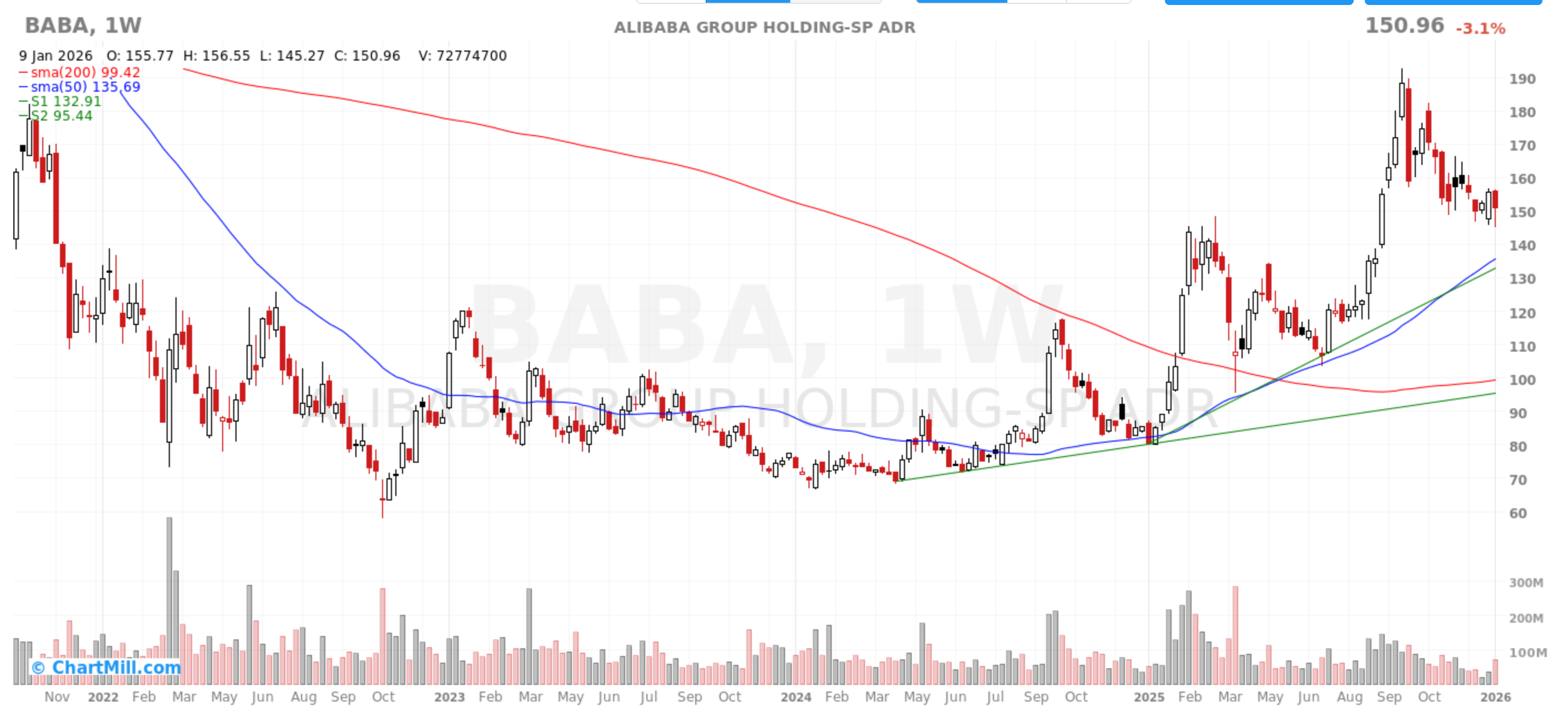
As a long-term shareholder, ideally this isn’t what happens. Since Kaspi management is committed to returning capital to shareholders through a combination of buybacks and dividends, a very gradual rising share price is most accretive. This way, shareholder capital is reinvested at great rates of return. Right now, by the way, Kaspi earns a near 60% return on equity and an almost 41% return on invested capital. Those are some great returns.
From a technical perspective, what we’d like to see happen is something like this, where KSPI 0.00%↑ consolidates around these levels, as buybacks eat the outstanding share count throughout 2026, leading into an explosive 2027 breakout. But I’m no technical wizard so don’t consider any of this seriously.
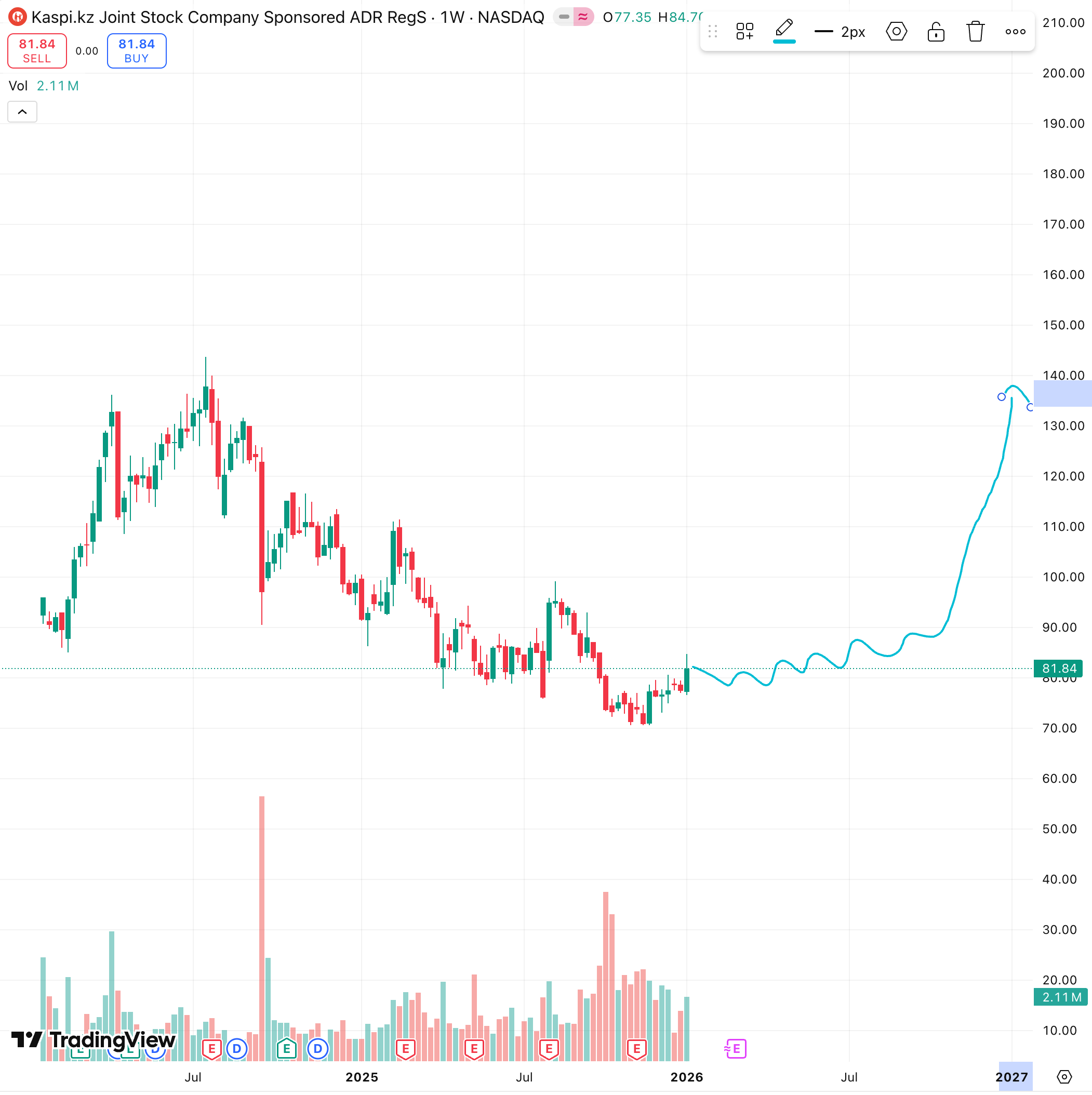
The point here is, don’t expect this to happen. Mr. Market can do anything. Maybe tomorrow, Mr. Market decides AI is a bubble and re-rates every equity to the downside by 50% (and in many high-beta cases much, much higher). Some speculative names with low revenue could see 95%+ re-ratings. At the end of the day, know what you’re buying. With Kaspi, you’re buying a cash printing machine, that is going to start sending that cash to you - the shareholders - this year, 2026.
As Charlie Munger liked to say,
If you can’t stomach 50% declines in your investment you will get the mediocre returns you deserve.
What Mr. Market does appreciate, though, is clarity. And hopefully that’s what we’ll get with Hepsiburada once the acquisition completes. Thus far, it’s unclear how much capex and how much of a drag Hepsiburada will be on Kaspi. If Kaspi is able to create a repeatable playbook with Hepsiburada, they’ll pass the point of Max q, maximum dynamic pressure. Kaspi could take this playbook and repeat it across multiple future acquisitions across central Asia. Who knows. Maybe Kaspi finds a market in Europe after all.
Thanks for following along, and here’s to 2026 shareholder returns 🍻

Been holding onto this for a year and it’s been a ride! Glad to see some positive press on it!
Hi here. Nice to connect. I have subbed. Let’s support each other and grow together. Check my last post on UBER here at this link. Feedbacks appreciated. https://substack.com/@valueinvestorfromitaly/p-192010627