
Fiserv
A Post Mortem for Superinvestors

Disclosure: Not financial advice. Do your own research.
What went wrong?
That’s the question you ask yourself, a superinvestor with a position in Fiserv. All the stars aligned; a wonderful compounder that fell off the horse. From a peak of around $230 down to $125 in October, to any value investor, that 46% drawdown makes their ears perk up.
So, you do some preliminary digging - very strong cash flows, a bit of a high debt load (though not overbearing), solid growth at 7% CAGR 5 years trailing, and a roughly 9% ROIC. The fundamentals check out, but what caused the re-rating in the equity? You look back at recent earnings calls, and there it is. July 23rd, management adjusted guidance downwards to top-line growth of 10% for FY 2025.
In a Manhattan corner office overlooking central park, you meet with your colleagues - fellow capital allocators managing in aggregate hundreds of billions - and you discuss. Your top analysts massage the numbers to construct a buy thesis. After hours of discussion and a few bottles of wine, a shared thesis emerges - the collective believes this is classic management sandbagging. Why wouldn’t it be? The new CEO - Michael Lyons - just assumed the helm on May 6, 2025.
Newly armed with this thesis, you start to look forward at what comes next for Fiserv. Analysis project earnings at around $9.20 per share in 2027; at a price of $125, that’s roughly a 13.5 multiple on a 2027 earnings. For a compounder growing top-line at strong rates, with increasing operating leverage, it’s difficult to say no.
You initiate a 5% position in Fiserv ($FISV) at $125 on October 8th.
Then, the floor drops out…
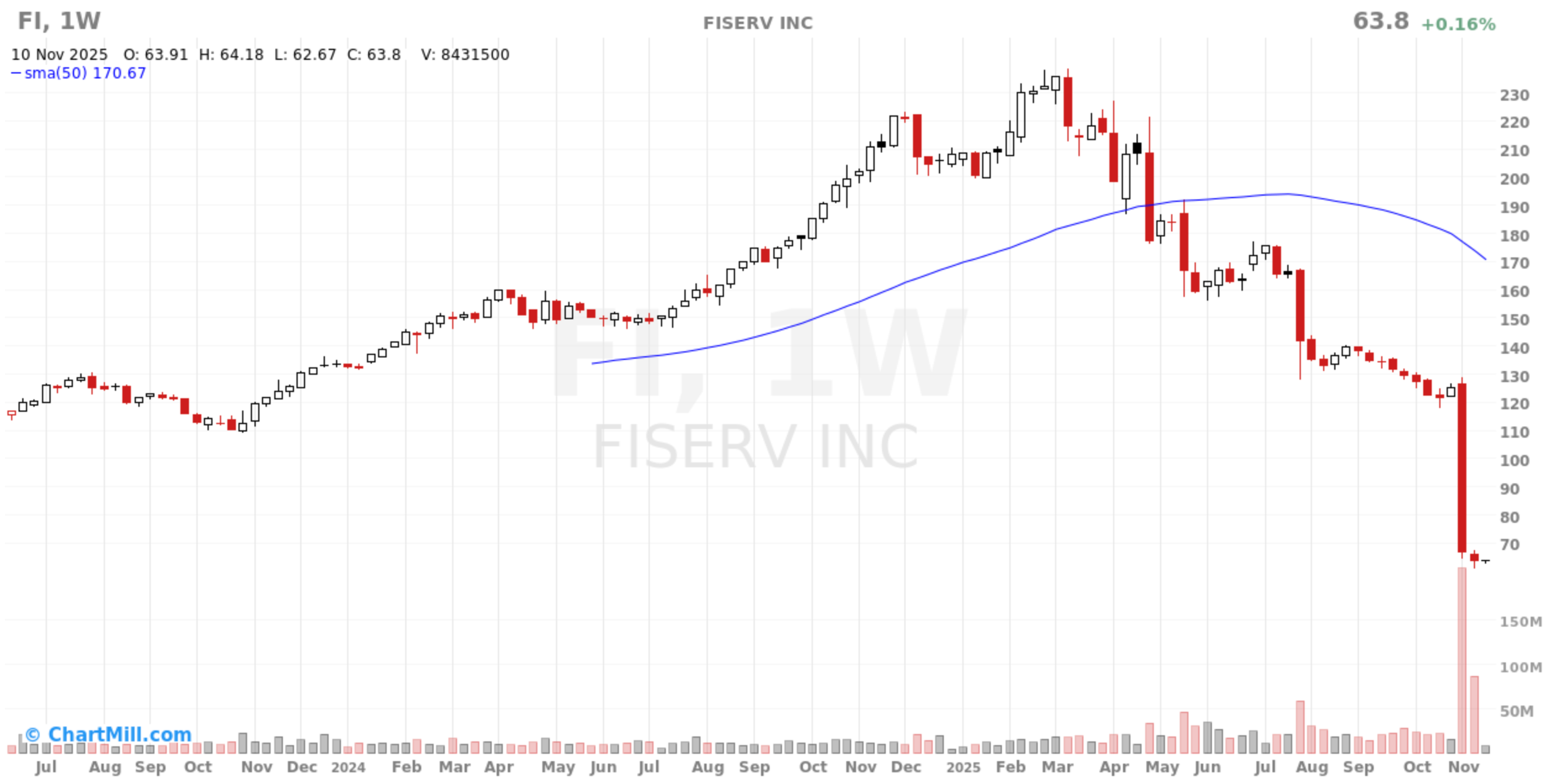
Fiserv releases their earnings report on October 29th. It’s a double miss. EPS of $2.04 misses the $2.64 estimate, sales of $5.263B misses the $5.360B estimate. Worse yet - management revises EPS guidance to between $8.50 and $8.60 downwards from $10.15 - $10.30 with revenues growing at 3% to 4% versus a prior estimate of 10%. When the Q3 earnings call begins, Mike announces that the company’s Argentinian operations were a major factor behind disappointing results. One of the few growth engines just came screeching to a stop.
Once the bleeding stopped, the stock ended up down from around $128 to $70.60, a 44% drop in a day - nearly $30 billion of market cap eviscerated. As of today, November 18th, Fiserv stock trades at $61.43, now a $33.6 billion market cap company.
“What went wrong?” You ask yourself. But this time your ears aren’t perking up, you briefly panic, then get angry, and grief quickly sets in thereafter.
Now, you have to go deeper. You review hundreds of hours of earnings calls, annual reports, analyst articles, interviews. You learn more.
In the past, Fiserv partnered with thousands of banks. When the merchant needed a POS, banks would refer Clover - Fiserv’s POS solution. But in the last couple years, this model started to collapse. Fiserv and Bank of America split ways. Then, so did Wells Fargo. Out with the old banking relationships, in with the neobanks and fintech solutions. From complexity to frictionless modern software solutions. It’s not that Clover suddenly loses all of it’s market - in fact POS solutions are very sticky - but instead, the existing bank channels driving new merchants to Clover is gone.
Although banks provide a segment of distribution directly, the majority of merchants sign up through sales channels. These are called ISOs or independent sales offices. And, spoiler alert, they’ve been crushed over the past decade or so as payments have been embedded in software. This trend isn’t stopping; in fact, with AI and other tailwinds it will accelerate even faster. Eventually, as these channels become saturated, growth through rate increases will take over as ISOs disappear. But for now, ISOs still sell POS systems. And what matters now is software. Unfortunately for Fiserv, software from players like Square, Stripe, sells better. But why?

It’s the developers. Always has been. Maybe it won’t be in the future with AI, but that’s a discussion for another time. Modern payment solutions like Stripe, Adyen, and Square leave a lot to be desired on their integrated solutions. Only Adyen has a comparable global reach to Fiserv at around 100 countries. What these companies did, and Fiserv failed at, is focus on the developers. The bolt-on strategy of growth through acquisitions only works in so far as investments are made into the products and services, allowing them to integrate and improve. That didn’t happen with Clover, and it’s developer experience lacks because of it.
Now, what happened with Argentina? Mike, the CEO, claims the woes are due to softened growth and “difficulty balancing long-term and short-term projects”. If you zoom out, it’s not that difficult to interpret. At some point the market becomes saturated, growth slows, and the story turns into one of stability and dividends. That shift demands a different multiple, simple as that. The discounted future cash flows now fall on a flatter growth curve.
All this screams of mismanagement; and usually, when managers leave a few problems, it turns into many. Lo and behold! That’s exactly what happens when you open Fiserv’s accounting books. A series of suboptimal decisions in fact. Over the past decade, Fiserv has been issuing significant debt, peaking in 2019 at $20 billion in order to fund the Clover acquisition (as part of First Data Corp). All the while, they’ve been repurchasing shares consistently; year-in, year-out. At the same time, debt repayment has been limited. Essentially, Fiserv has performed levered share buybacks using debt. As it turns out, that’s all fine and dandy when the stock is on an upwards trajectory. But once things turn south, it becomes a problem. And now, Fiserv is left with over $30 billion in debt, while only having reduced the outstanding share count from a peak of 679 million in 2020 to todays share count of 555 million - a roughly 18% reduction. The total debt pile is now nearly equal to the market cap of the company, with its net debt nearly the same (at $27 billion vs a market cap of $33 billion).
What does this all mean for the superinvestor?
The fundamentals of the business haven’t changed, the expectations have. The bar was set too high. And now you’ve got a business with solid growth, a sizable debt pile, and a FCF yield of 13.54%. The market has force-reset growth expectations. On one hand that hurts the share price. But on the other, it lets management off the hook for doing it themselves. The bar is now very low.
After a c-suite shuffle, management must do a few things.
Plug the holes. Ensure no more water is leaking in the boat by addressing operational shortcomings, reorienting KPIs and goals to build a foundation to reignite growth.
Cut waste. Fortunately the business isn’t losing money, so layoffs aren’t necessary. What is unnecessary are share repurchases. This wasteful allocation of capital needs to stop.
Reduce liabilities. Build a plan to pay off the cumbersome debt load, and ideally refinance at lower interest rates in the near-future.
So what does the superinvestor do? Well, buy of course!
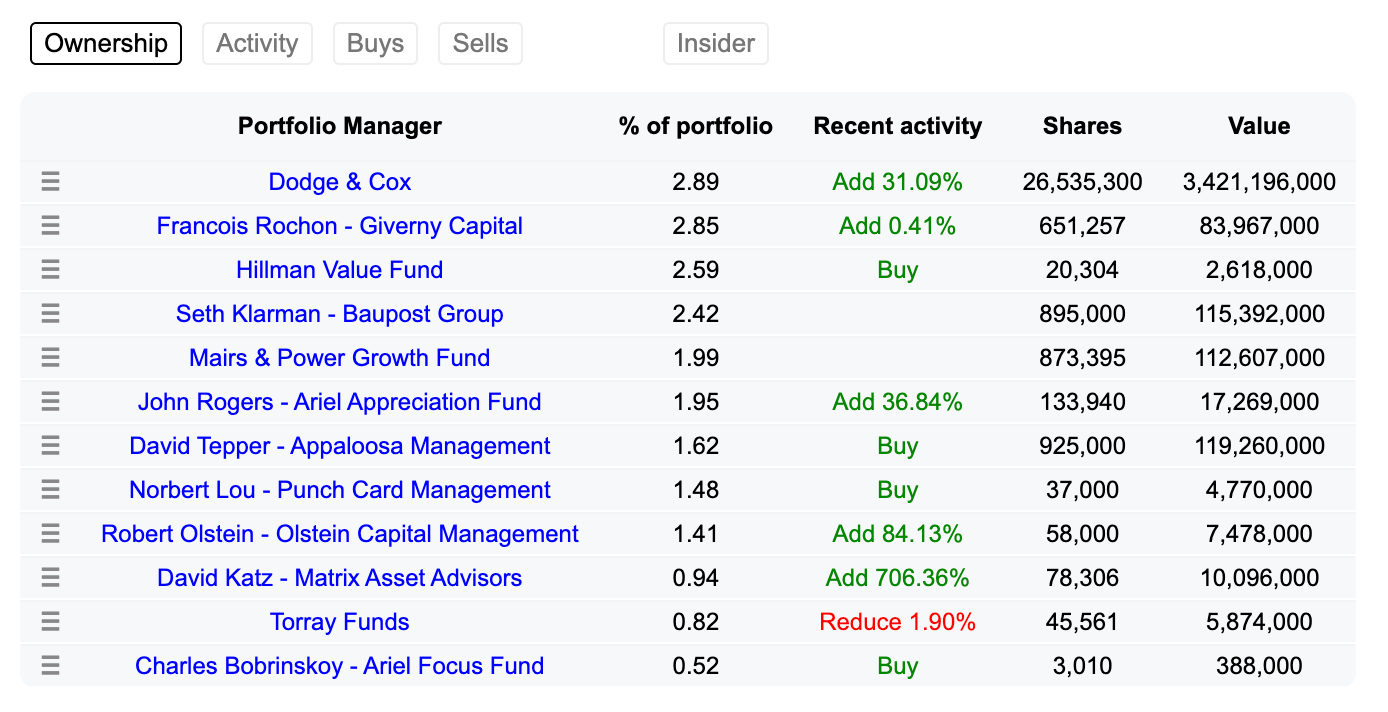
Superinvestors look at the fundamentals of the business, and now more than ever Fiserv’s fundamentals are priced at a discount. If you take Fiserv’s 13 year historical median earnings multiple of 24x (significantly lower than the last 10 year average of aroun 38x), applying that to 2027 analyst earnings projections gives Fiserv a valuation of roughly $146 billion. Factoring out $30 billion of debt, leaves $FISV at a market cap of $116 billion on 2027 earnings. At it’s current market cap of $33 billion, that’s nearly a 250% upside. Note though, this is the optimistic napkin math where management turns the ship around, allowing the stock to re-rate back up to a multiple of 24, while it currently trades at a multiple of around 9x.
Fiserv’s collapse wasn’t the product of a broken business, but of broken expectations. Years of elevated multiples masked deteriorating distribution, uneven execution, and an undisciplined balance sheet. Yet at today’s valuation, the market is no longer pricing Fiserv for perfection. It’s barely pricing it for survival. If management can demonstrate even the early signs of operational repair - plugging channel leaks, investing into the Clover ecosystem, restoring discipline to capital allocation - the valuation gap does not need heroics to close. It only needs competence.
That is the bet a superinvestor makes here: not that Fiserv becomes Stripe or Adyen, but that it becomes a well-run version of itself. At $61 per share, the downside is largely known. The upside, should the company reclaim even a portion of its former multiple, is extraordinary. And that’s precisely where great investments tend to hide: panicked markets turning once-loved securities into hated reminders of risk.

References
We’re confused how the market is confused about Fiserv. (2025, November 11). Reforming Retail. https://reformingretail.com/index.php/2025/11/11/were-confused-how-the-market-is-confused-about-fiserv/
Leave a comment or join us in our chat if you enjoyed this read.

Excellent analysis, very well presented. Thank you.